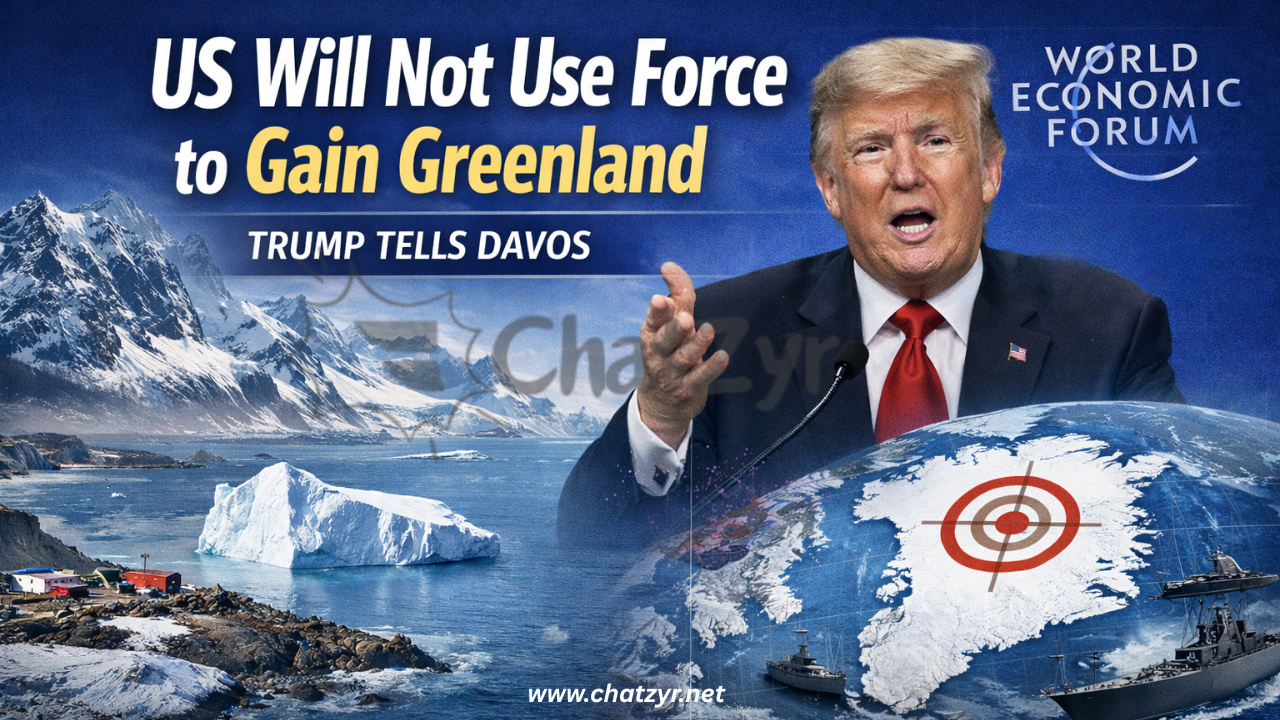
US Will Not Use Force to Gain Greenland, Trump Tells Davos
Donald Trump said the United States would not use military force to acquire Greenland, addressing international leaders and executives during a session at the World Economic Forum in Davos, as renewed attention focuses on the Arctic’s growing geopolitical importance.
Speaking at the gathering, Trump acknowledged Greenland’s strategic and economic value but stressed that any US interest in the Arctic region would be pursued through peaceful engagement, dialogue, and cooperation, rather than coercion. His remarks were seen as an attempt to ease international concerns amid heightened global competition over resources and strategic locations.
Greenland’s Rising Strategic Profile
Greenland, an autonomous territory within the Kingdom of Denmark, occupies a key position between North America and Europe. Though sparsely populated, the island has gained increasing attention due to its proximity to vital shipping routes, military infrastructure, and its vast untapped natural resources.
Accelerating climate change has reduced Arctic ice coverage, opening new maritime corridors and improving access to mineral reserves. These developments have transformed Greenland from a remote territory into a focal point of global strategic interest.
Clarifying US Intentions
Trump’s comments at Davos appeared aimed at clarifying Washington’s position on Greenland at a time when Arctic politics are becoming more complex. By ruling out the use of force, he sought to underline that US engagement in the region would respect sovereignty and international norms.
Observers noted that the remarks were particularly relevant for European partners, including Denmark, which oversees Greenland’s defense and foreign affairs. The statement was interpreted as a signal that any future cooperation would be based on consent and partnership rather than pressure.
The Arctic and Global Competition
The Arctic has emerged as a new arena of geopolitical rivalry. Russia has expanded its military footprint in the region, reopening bases and investing in Arctic infrastructure. China, while not an Arctic state, has increased its involvement through research missions and long-term economic planning tied to polar trade routes.
Against this backdrop, Trump told the Davos audience that competition in the Arctic must be managed carefully. He warned that militarising the region or pursuing unilateral actions could destabilise global security and disrupt international trade.
Economic Interests and Resource Potential
Greenland is believed to hold significant reserves of rare earth minerals, which are critical for advanced technologies, renewable energy systems, and defense industries. As global demand for these materials rises, competition over supply chains has intensified.
Trump highlighted the economic dimension of Arctic engagement, arguing that responsible investment and technological cooperation could benefit both local populations and international partners. He suggested that economic development should not come at the cost of political stability or environmental damage.
Environmental Concerns in the Arctic
Environmental protection was also raised as a key issue. The Arctic is one of the most fragile ecosystems on the planet, and experts warn that unchecked exploitation could cause irreversible harm.
Trump said sustainable development must remain a priority, noting that innovation and modern technology could help balance economic growth with environmental responsibility. He stressed that long-term stability in the Arctic depends on protecting its environment as well as its people.
International Reactions and Analysis
Political analysts described the Davos remarks as a recalibration of tone rather than a detailed policy announcement. While the statement did not outline specific steps, it was viewed as an effort to reassure allies and investors that US interests in Greenland would not be pursued aggressively.
European officials welcomed the emphasis on peaceful engagement, noting that Arctic stability depends on cooperation among regional and global stakeholders. Greenlandic leaders have consistently maintained that any external involvement must respect local decision-making and support sustainable development.
Implications Going Forward
While no concrete policy initiatives were announced, the comments suggest that future US engagement in the Arctic will likely focus on diplomacy, research cooperation, and economic partnerships. Experts say continued coordination with NATO allies and Arctic states will be essential to avoid misunderstandings and escalation.
The statement also reflects broader concerns discussed at Davos, where leaders focused on geopolitical fragmentation, climate risks, and economic uncertainty. Trump’s remarks aligned with calls for restraint and dialogue in strategically sensitive regions.
Conclusion
By stating that the United States would not use force to gain Greenland, Donald Trump sought to send a message of restraint at a time of growing Arctic competition. As climate change and global demand for resources reshape the region, Greenland will remain central to international discussions on security, development, and cooperation.
How major powers manage their interests in the Arctic may determine whether the region becomes a platform for collaboration or a new source of global tension.
Publish Credit: chatzyr.net