
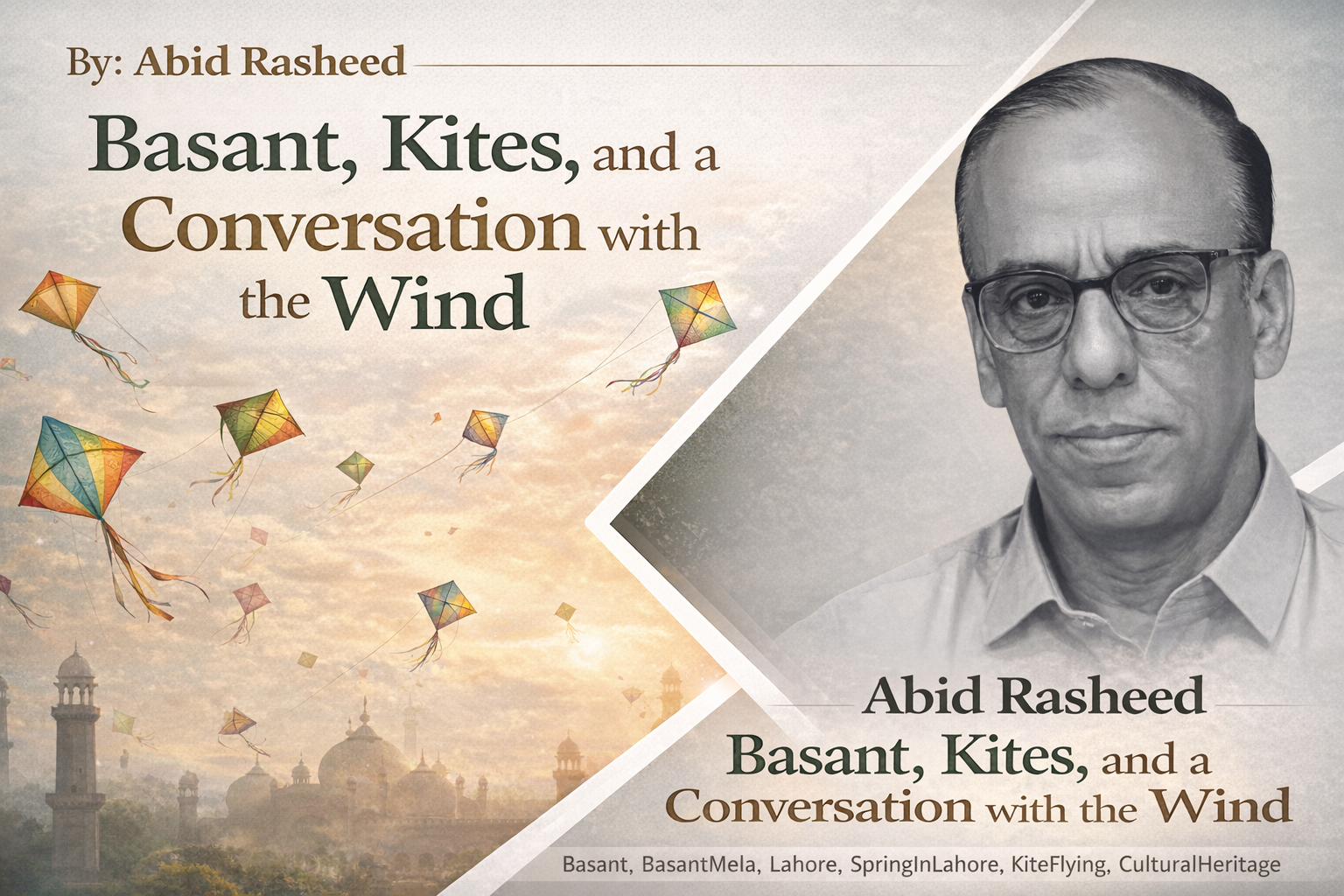
Basant, Kites, and a Conversation with the Wind - Abid Rasheed
By Abid Rasheed | Chatzyr
Lahore—rightly called the cultural capital of Pakistan—once again stands at the threshold of spring. A faint yellow settles into the air, buds stir on bare branches, and rooftops awaken in colour as kites begin to rise. As the provincial government prepares for its three-day Basant Mela, it becomes clear that what unfolds here is far more than a festival. It is the reverberation of an ancient human impulse—where memory, myth, devotion, and imagination meet the open sky.
Today, kite-flying is seen as seasonal recreation or spirited competition. Yet its origins lie far from play. In its earliest forms, the kite was sacred—an instrument through which human beings attempted to reach upward, to negotiate with unseen forces, and to open a fragile channel between earth and heaven.
Conventional history traces the kite’s birth to ancient China, long before the Common Era. There, kites were used for military signalling, measurement, ritual, and the study of wind. But this familiar narrative has grown more complex. Archaeological traces and indigenous mythologies suggest that kites were flown independently in places as distant as New Zealand and the Hawaiian Islands. These findings challenge the idea of a single origin and point instead to something more elemental: wherever human beings gazed at the sky and longed to rise, the kite emerged.
What unites these ancient cultures is that the kite was never merely an object of leisure. It was an object of reverence. Kites were flown to please gods, ward off malevolent spirits, and invite benevolent forces. In Māori mythology, a god himself becomes a kite; in Hawaiian lore, the demigod Māui is shown flying one. These stories are not simple fantasies—they reflect a worldview in which flight itself was sacred, and elevation signified proximity to the divine.
In the subcontinent, Basant and kite-flying are woven into an equally rich spiritual and cultural fabric. Shahid Ahmad Dehlvi, in Dilli Jo Ek Shehr Tha, records how Hindus welcomed spring by offering mustard flowers at temples—a ritual known as Basant. The Sanskrit word Basant itself means spring. Over time, Muslims absorbed this celebration into their own spiritual life. The flowers moved from temples to Sufi shrines, and Basant became a quiet symbol of shared culture and syncretism.
Tradition traces this transformation to Amir Khusro. One spring day, he arrived before his spiritual master, Khwaja Nizamuddin Auliya, carrying yellow flowers and dancing with joy. When asked about his state, Khusro replied:
“عرب یار تو ری بسنت منائی۔ آج ہندو اپنے بت پر بسنت کے پھول چڑھانے جا رہے ہیں، میں بھی اپنے بت پر پھول چڑھانے آیا ہوں۔”
Moved, the saint recited:
“اشک ریز آمد و ابرِ بہار
ساقیا گل بریز، بادہ بیار”
From that moment, a tradition took root. Each spring, flowers were offered at shrines, khatm was recited, sweets were shared, and music and movement became expressions of spiritual joy. Basant was no longer only seasonal—it became emotional, mystical, and communal.
History adds further texture. The Encyclopaedia Britannica notes that in the fourth century BCE, the Greek mathematician Archytas experimented with flight in an effort to imitate birds—an early scientific precursor to the kite. A nineteenth-century miniature painting, now in the British Museum, depicts Radha running after the shadow of a kite flown by Krishna. Romantic though it is, the image reveals how deeply the kite had entered the subcontinent’s imagination. References to kite-flying appear in the verses of Bihari, Kabir, Rahim, and Tulsidas, confirming its long presence in South Asian literary consciousness.
In China and Japan, kites were believed to drive away evil spirits and summon good ones. Certain days were considered auspicious for flying them, while fallen kites were often left untouched, thought to carry misfortune. In the third century BCE, philosopher Han Fei Zi recorded a story—attributed to earlier times—of Lu Ban and Mozi constructing a wooden kite capable of lifting a man into the air. He remained aloft for three days before falling. The people revered him as divine. Legend or history, the meaning endures: flight was seen as transcendence.
Elsewhere, kites assumed remarkable forms. In Guatemala, the Maya still fly kites in graveyards on the Day of the Dead, believing they help communicate with ancestors. In Malaysia and Papua New Guinea, kites were used for fishing, skimming water surfaces with hooks attached—turning wind into sustenance.
It was in China that kite-flying gradually transformed into recreation. Competitions and aerial battles turned sacred objects into playful art. Buddhist monks carried the tradition to Japan, where by the seventh century kites became integral to festivals marking the New Year, childhood milestones, and agricultural cycles.
Beyond ritual and play, the kite endures as metaphor. A saying often misattributed to Winston Churchill notes that a kite rises against the wind, not with it. Similar thoughts appear in the writings of European thinkers and in Chinese poetry, including lines attributed to Zhang Ke, later echoed across generations. The idea is universal: resistance does not always pull us down—it can lift us higher.
Ultimately, the story of Basant and kite-flying is not about nostalgia or spectacle. It is about humanity’s ongoing conversation with the sky—about faith, struggle, imagination, and hope, bound together by paper and string. The kites soaring above Lahore’s rooftops today are centuries-old dreams in motion, reminding us that elevation is rarely achieved without resistance, and that the very wind we struggle against may be what allows us to rise.
Published on Chatzyr.net
Written By : Abid Rasheed