bangladesh
Bangladesh Gen-Z Political Party Faces Internal Revolt Over Religious Alliance
#BangladeshGenZParty#NationalCitizenPartyBangladesh#BangladeshPoliticalCrisis
9mo ago • Dec 29, 2025, 06:26 PM • Updated 2mo ago
3 min read
Bangladesh’s Gen-Z Party in Crisis as Religious Alliance Triggers Internal Revolt
Dhaka, Bangladesh — A youth-led political party born from Bangladesh’s 2024 uprising is facing a deep internal crisis after announcing an election alliance with Islamist party Jamaat-e-Islami, a move analysts warn could undermine its future and strengthen established political rivals.
At least 30 senior leaders of the National Citizen Party (NCP) have publicly opposed the alliance since it was announced on Sunday, with several resignations highlighting growing unrest inside the Gen-Z-driven party.
Bangladesh, a Muslim-majority South Asian nation, is scheduled to hold national elections on February 12.
Religious Alliance Sparks Backlash
Before the controversial deal, opinion polls had placed Jamaat-e-Islami as a close second behind the Bangladesh Nationalist Party (BNP), led by former Prime Minister Khaleda Zia, while the NCP trailed in third place.
Political observers say the alliance risks diluting the party’s core identity.
“The NCP presented itself as a youth-driven alternative to traditional power structures. That identity is now under serious strain,” said academic H.M. Nazmul Alam. “Youth movements fail not only when they lose elections, but when they lose internal unity and clarity.”
From Protest Movement to Political Test
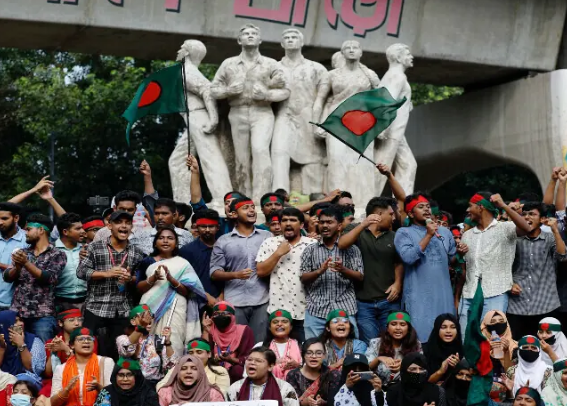
The National Citizen Party was formed earlier this year by leaders of the mass protests that forced Prime Minister Sheikh Hasina to flee to India in August 2024, ending her long rule.
Led largely by Gen-Z activists, the party pledged to challenge decades of political dominance by Hasina’s Awami League and the BNP, promising a new political culture free from nepotism.
With the Awami League now banned, the upcoming election is expected to be largely contested between the BNP and Jamaat-e-Islami. Jamaat had previously been barred from elections after a court ruled its registration conflicted with Bangladesh’s secular constitution, but restrictions were lifted in August 2024 by an interim government led by Nobel laureate Muhammad Yunus.
Leadership Defends Alliance Decision
NCP leader Nahid Islam, 27, defended the alliance at a press conference, saying recent political violence had forced the party to seek broader unity.
“The forces we overthrew are attempting to sabotage the election,” he said. “For the sake of greater unity, we reached an electoral understanding with Jamaat.”
He acknowledged dissent within the party but said opposing members were free to make their own decisions.
Resignations and Warnings from Analysts
One high-profile resignation came from Tasnim Jara, a medical doctor who returned from Britain to join the NCP. She has since announced plans to contest the election as an independent candidate.
“I promised to fight for a new political culture,” she wrote on Facebook. “Whatever the circumstances, I am determined to keep that promise.”
Political analyst Asif Shahan of the University of Dhaka warned the alliance could erase the party’s ideological foundation.
“If you align with Jamaat, it benefits Jamaat — not you,” he said. “It gives them legitimacy, while your centrist identity will simply disappear.”
A Test for Youth Politics in South Asia
Analysts say the NCP’s struggle highlights the difficulty of transforming protest movements into electoral success, offering lessons for countries like Nepal, where youth-led protests have also reshaped politics ahead of upcoming elections.
As Bangladesh approaches the polls, the future of the Gen-Z political experiment now hangs in the balance.